About Tolstoy Today
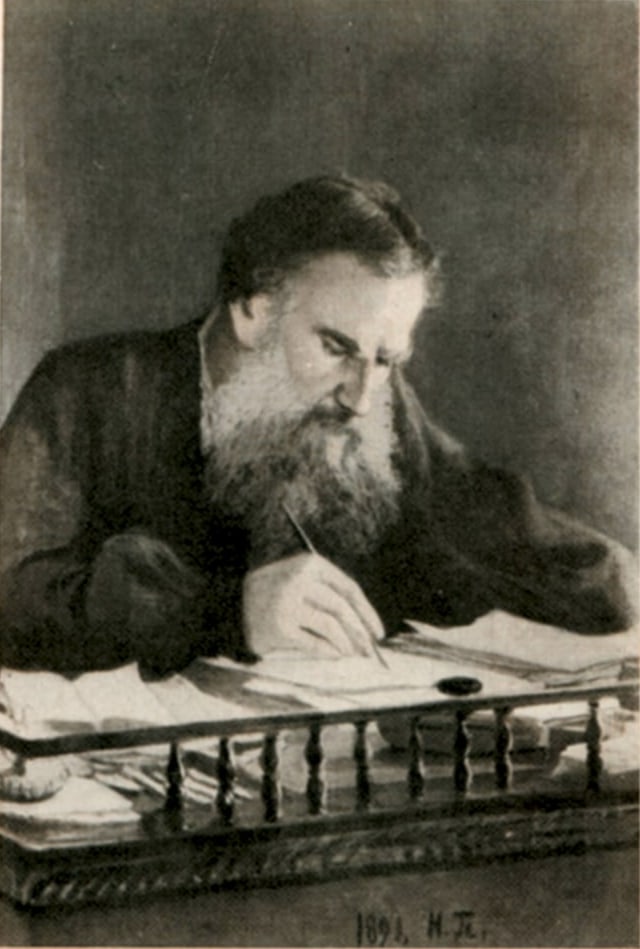
In the last years of his life, Leo Tolstoy compiled Circle of Reading («Круг чтения»), a book of daily readings drawn from the wisdom of many centuries and peoples and joined with thoughts of his own. Tolstoy Today presents it in the original Russian and in a new English translation, and traces its quotations to their sources.
The idea had come to him twenty years before, in his diary:
“I must put together a circle of reading for myself: Epictetus, Marcus Aurelius, Lao-Tzu, the Buddha, Pascal, the Gospel. Everyone would need this too.”
Tolstoy, diary, March 15, 1884 (Jubilee edition, vol. 49, p. 68)
When he set to work in 1904, the circle widened to Seneca and Cicero, Confucius, the Talmud, Saadi, Thomas à Kempis, Montaigne, Rousseau, Kant, Schopenhauer, Ruskin, Emerson, and Thoreau, among many others.
The book has a page for every day of the year, and one more for leap years. Each page opens and closes with a thought of Tolstoy’s, with the passages he chose between. Each week adds a longer reading, such as Hugo’s “Bishop Myriel,” Tolstoy’s own “Divine and Human,” Herzen’s “The Damaged Man,” and the early Christian Teaching of the Twelve Apostles.
Tolstoy left his own thoughts unsigned. A passage with no name beneath it is, as a rule, his.
“I cannot tell you how much joy this work on the Circle of Reading gives me.”
Tolstoy to V. G. Chertkov, February 10, 1908 (Jubilee edition, vol. 89)
Editor’s Note
A comedian once joked, “I took a speed-reading course and read War and Peace in twenty minutes. It has something to do with Russia.”
My knowledge of Leo Tolstoy was vague. I attempted to read War and Peace, but settled for the movie. I didn’t understand Tolstoy’s depth or importance until a friend, JW, introduced me to the Circle of Reading. His recommendation changed my life.
I wanted a good way to access Tolstoy’s daily readings in English. After some searching, I found translations, but they weren’t great for online use. I could use my web-building skills to make a quality study site for this epic volume, but I needed a copyright-free translation.
Since I don’t speak Russian, I enlisted Claude AI to translate the volume and offer it as a public-domain resource. (More about this work below.)
This website is designed to be an example of how machines can help coordinate and assemble data for literary research.
Tolstoy took to one new machine himself. Thomas Edison sent him a phonograph as a gift, and early in 1908 Tolstoy spoke two of the Circle’s weekly readings into it (see Tolstoy’s Voice). That December, Edison sent two men to Yasnaya Polyana, Tolstoy’s estate, to record him.
I hope Tolstoy Today can bring the author’s collection of wisdom to today’s readers in a format that he himself would find joy in using.
David Neufer
Editor, Tolstoy Today
Reading Tolstoy Today
- The home page presents today’s reading. Follow it from Tolstoy’s opening thought, through the passages he gathered, to his closing thought.
- Under the header of a day’s page, a line leads to the day before and the day after, to the week’s reading, and back to Today. On a phone, the bar at the foot of the page does the same, and a swipe to the left or right turns to the next or the previous page in the book’s order, the week’s reading after its seventh day (Swipe between days, under settings, turns it off).
- Calendar opens any day of the year.
- Studies holds three studies of the book: Authors, everyone Tolstoy quotes, the writers A to Z by surname, each with their passages in the order of the year; Tolstoy’s Themes, the theme of each day; and Leo Tolstoy as Editor, how he changed what he quoted. The name under a passage leads to its author’s page.
- Choose Compare to set Tolstoy’s Russian beside the English, passage by passage, or Русский for the Russian site, where the whole site is in Russian.
- Show sources puts what is known of each quotation’s source beneath it. Click a source to open it and see what Tolstoy did with the original: kept it, shortened it, changed it, or joined several passages into one. November 28 is a good day to try.
- Copy link copies the address of the page, at the head of a day’s page or a week’s reading and at the foot of every other page. In the app installed on a phone, which shows no address bar, it is the way to send a page.
- Use Tt for the size of the text, and light or dark for light or dark, warmth, and brightness. On a phone they are under settings, with the language.
The Russian text
The Russian is Tolstoy’s 1908 revision as printed in the Jubilee edition of his complete works (volumes 41 and 42, 1957), now free to read at tolstoy.ru. The printings of 1906 to 1912 were cut by the tsar’s censors: the first publisher was prosecuted, and the book could be sold again only after twelve passages were destroyed. The Jubilee editors restored what had been cut.
The English translation
The English is a new translation from Tolstoy’s Russian, made for this edition.
Tolstoy quoted many English and American writers, among them Ruskin, Emerson, and Thoreau, in his own Russian translation. Where his Russian follows the original closely, this edition prints the writer’s own English instead of translating Tolstoy’s translation back again. Show sources gives Tolstoy’s version.
Free to use
The Tolstoy Today translation is in the public domain. Anyone may use it, whole or in part, for any purpose, without asking, paying, or giving credit. The same holds for its notes and for the source data behind the site. All three are given to the public domain under CC0, the Creative Commons dedication that gives up every right to a work.
In this, Tolstoy Today follows the author’s stated wish. He wanted his writings to belong to everyone. In September 1891 he announced in two newspapers, Russkiye Vedomosti and Novoye Vremya, that anyone might publish, free of charge, whatever he had written since 1881 and whatever he would write later. The Circle, first printed in 1906, is one of those later writings. In 1908 he wrote to a Polish journalist, “I long ago gave everyone the right to reprint and translate all my writings since 1881.” He died in 1910, and his work is now out of copyright everywhere.
The Jubilee volume keeps to his wish: it is printed with the line «Перепечатка разрешается безвозмездно», “Reprinting is permitted free of charge.” The quoted authors’ own words, where they are printed, and the excerpts under Show sources come from editions old enough to be in the public domain. Nikolai Ge, who painted the portrait, died in 1894.
Other English translations of the Circle belong to their translators and are not used here.
Credits
With thanks to those who keep Tolstoy’s Russian free: the Leo Tolstoy State Museum, the Yasnaya Polyana Museum-Estate, the Russian State Library, ABBYY, and the more than three thousand volunteers of «Весь Толстой в один клик» (All of Tolstoy in One Click), who made the Jubilee edition free to read online; and to Wikimedia Commons, Project Gutenberg, the Internet Archive, Wikisource, and the other libraries whose public-domain texts the sources are checked against.
The translation and the source research are the work of two AI models. Claude Opus translated Tolstoy’s Russian and searched out the sources of its quotations; Claude Fable read every passage a second time against the Russian.
About the Translation Process
Each month goes through the same steps, and each step leaves a record in the project’s files.
- The Russian text. The work starts from the digital Jubilee volume at tolstoy.ru, which a small program divides into days and passages. The digital text has a few slips, most of them from scanning: Latin letters standing in for Cyrillic ones that look the same, an entry number lost or misread, the end of one passage run into the opening of a day. Each is mended, and each repair is listed.
- The translation. Claude Opus translates each day from the Russian. The editor’s rulings settle the choices that recur through the year, such as when to print an English writer’s own words, and a glossary holds the book’s key terms to one English word each. Notes under a passage explain an idiom, a misprint, or a choice of word. No other English translation of the book is used.
- A second reading. Claude Fable then reads every passage against the Russian on its own and lists what it finds: errors, doubts, and weaker phrasing. Each point is weighed against the Russian. For October 1 to 22 and 30 and 31, November, December, January, February, March, April, May, June, July, August, and September it raised 526 points, nine of them errors, and all but six led to a change. Once the translator had taken a phrase for a misprint in the Russian; the second reading showed the Russian was right.
- Finding the sources. For each signed quotation, the search is for the book Tolstoy took it from. Often that is an anthology he read in French, German, or English, such as Pauthier’s French Confucius or a German collection of sayings from Kant, rather than the author’s own work. The source texts are public-domain editions, saved for the purpose, and a program checks that every excerpt shown under Show sources appears word for word in its saved text. Of the 1,594 signed quotations in the book, 1,387 have been found and checked, 54 are probable, and 153 are not yet found. Every paragraph of the weekly readings has been traced.
- What the sources show. Tolstoy often shortened, joined, or rewrote what he quoted, and the source panel says which. A few names are wrong: a passage signed Anatole France is Voltaire’s, two signed “Brahmin wisdom” come from Helena Blavatsky’s The Voice of the Silence, and a saying given to the Talmud is Proverbs 20:27. Where the right name is certain, it follows in brackets, as the Jubilee editors did with the mistakes they caught; where it is not, the doubt is noted in the source panel. And a line still quoted as Marcus Aurelius’s, on October 23, is Tolstoy’s reworking of the Meditations.
- Our own mistakes. These are recorded too. When November first went online, a printed rule partway through Hugo’s “Bishop Myriel” was taken for the end of the day, and the story’s last 29 paragraphs appeared as November 24’s closing thought. It was put right the same day.